Japanese Closet Organization for a Small Bedroom
Organize a small bedroom closet by matching hanging space, drawers, seasonal storage, and renter-friendly add-ons to the closet you actually have.

A small bedroom closet is not one standard problem. A narrow reach-in closet, a deep Japanese oshiire, and a bedroom with no built-in closet need different layouts. The useful lesson in Japanese small-space examples is not a particular container. It is the way hanging clothes, folded clothes, bedding, and seasonal items are assigned to different zones.

Start with the closet you actually have, then choose the least permanent setup that makes the daily rotation easy to reach. This guide uses selected RoomClip photos as concrete examples of possible layouts, not as evidence that any one method is typical across Japan.
Identify the closet before choosing storage
Open every door and note what blocks access. Sliding doors, bifold doors, fixed center panels, base tracks, and a narrow doorway can make part of the interior difficult to reach even when the measured width looks generous.
- Reach-in closet: prioritize clear door access, hanging drop, and drawers that can open fully.
- Deep oshiire: divide the depth and fixed shelf into front, back, upper, and lower zones.
- No built-in closet: give one freestanding rack or wardrobe a firm width and capacity limit.
Measure usable space, not just wall-to-wall width
Record the clear door opening, interior width and depth, top-shelf clearance, hanging-rod height, and the drop required by your longest garment. Also measure baseboards, tracks, hinges, and handles that can stop a drawer from opening.

Separate full-length garments from shirts and folded pants before adding a second rail or shelf. Short garments can sit above drawers or another hanging level; coats and dresses still need an uninterrupted drop.
Translate an oshiire layout carefully
An oshiire is a deep Japanese storage compartment traditionally designed around folded bedding. Its fixed middle shelf creates two large levels, and it may have no built-in hanging rod. That differs from the shallow, rod-first layout common in many U.S. reach-in closets.

The transferable idea is zoning: bulky or less frequent items can use the deep rear or upper area, while daily clothing stays near the opening. Do not assume an oshiire-sized insert, tension rod, or drawer unit will fit a U.S. closet without measuring it.
Use removable inserts when permanent work is unnecessary
Freestanding drawers, shelf inserts, and modular frames can divide a closet without changing the original rod or shelf. They are often easier to move than a custom built-in, but they still need stable footing and enough clearance for doors and drawers.

Match drawers to the clothes above them
Drawers are useful for T-shirts, underwear, sleepwear, and other foldable categories. Their height should be set by the hanging clothes above, not by the largest tower that fits the floor.

Leave hems clear of the drawer top, make sure every drawer opens past the closet door, and avoid creating a top surface that becomes an unplanned pile. If long garments dominate the wardrobe, place drawers beside them rather than underneath.
Let the current season use the easiest space
The smallest closet should not give equal access to every garment owned. Keep the current season and frequently worn pieces at eye and hand level. Move formalwear, special-event items, and the off-season rotation to a higher, deeper, or separate contained zone.

This is a capacity decision, not a request to buy matching bins. If the active rotation still cannot return to the closet easily, reduce what stays in that zone before adding another organizer.
When there is no closet, contain one open rack
A freestanding rack can create hanging space in a closet-free bedroom, but open storage becomes part of the room visually. Use it for the active rotation, keep the floor path clear, and contain small or folded categories in drawers rather than hanging bags from every edge.
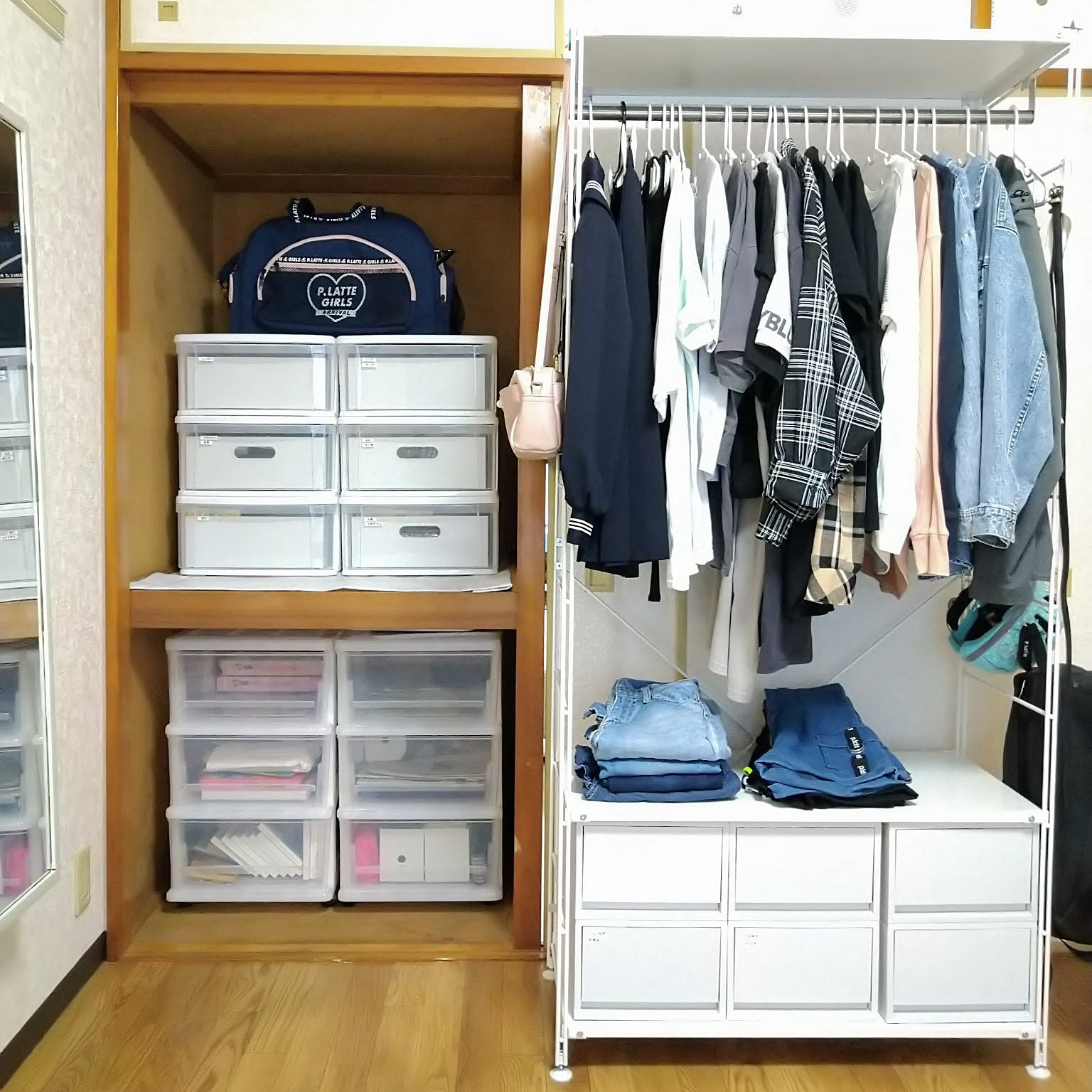
Choose a rack only if the bedroom has a stable placement outside the door swing, heater clearance, and walking path. If the complete wardrobe must stay hidden, a closed freestanding wardrobe is a better fit even though it uses more visual and floor space.
Control deep storage with front and back priorities
Deep storage can hold more, but it can also hide small items. Keep daily categories at the front in drawers or clearly separated bins. Reserve the rear and lowest hard-to-reach zones for labeled, infrequently used items that can be removed as one unit.

Do not compress every fabric simply to maximize capacity. Follow garment and bedding care instructions, keep items dry before storage, and leave the ventilation paths required by the room and storage products.
Choose the layout by constraint
- Narrow opening: use one accessible drawer stack and reserve the obstructed corner for infrequent items.
- Mostly short garments: consider drawers or a second hanging level below the main rod.
- Many coats or dresses: protect full-length hanging space and move folded clothes elsewhere.
- Deep oshiire: zone by access frequency and add a measured freestanding insert only where needed.
- Rental: favor freestanding parts; verify any tension or adhesive fitting before use.
- No closet: limit one open rack to the current rotation or choose a closed wardrobe.

A successful layout is one the actual user can reset: daily clothes return without moving another bin, drawers open past the door, and less frequent items remain reachable as complete units. If that test fails, change the zone assignment before adding more storage hardware.
Frequently asked questions
What is an oshiire, and is it the same as a closet?
What should I do first in a very small bedroom closet?
Should I use drawers or hanging storage in a small closet?
How can renters add closet storage without drilling?
What if the bedroom has no closet?
by Japanese Home Goods Editorial
RoomClip usage context, manufacturer specifications, and US-market availability are reviewed by the Japanese Home Goods editorial team. We do not claim hands-on testing unless an article explicitly says so.
Related Articles

How to Air-Dry Clothes Indoors in a Small Apartment
Pick one drying spot that fits a single load, space the clothes so air can pass between them, keep the room's humidity down, and put the rack away once it is dry.

Japanese Bathroom Storage Ideas for Small Apartments
Make a small Japanese-style bathroom easier to clean with magnetic, hanging, tension-pole, and removable storage ideas that keep bottles and tools off the floor.

Japanese Entryway Organization Ideas for Small Apartments
Plan a small entryway with the trays, shelves, and storage you already own. Test the door swing, fit shoes to your shelves, and check rental rules before buying more.